
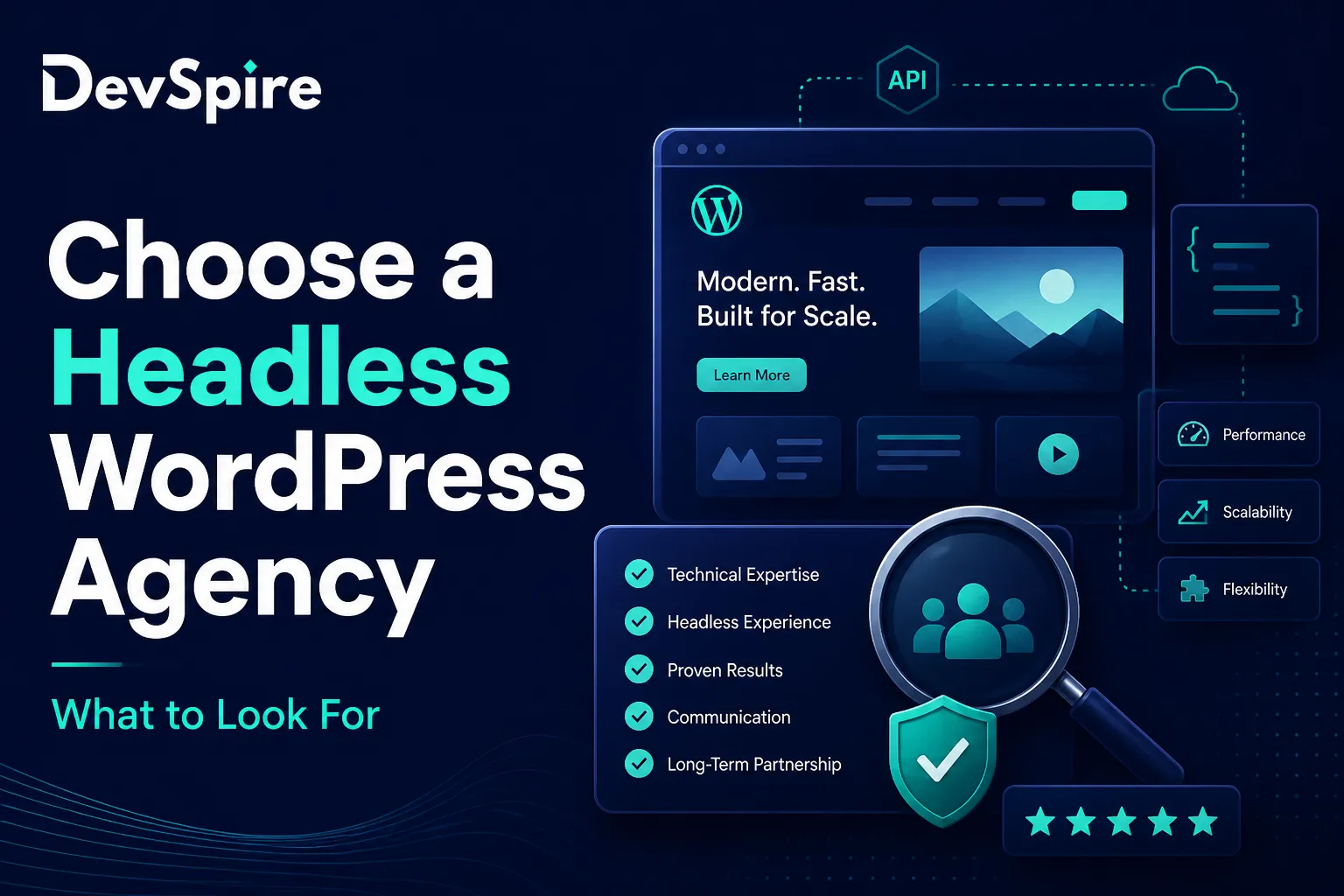
How to Choose a Headless WordPress Development Agency

Picture of By DevSpire Inc

By DevSpire Inc

Headless WordPress Development Agency

Headless WordPress has been around for a while, but more businesses are moving toward it every year. The appeal is real: faster page loads, more flexible design, and the ability to push content to multiple platforms at once. But getting it right takes more than just hiring a WordPress shop and hoping for the best.

A headless setup separates your WordPress backend from the frontend your visitors actually see. That means more technical complexity on every level, from hosting and APIs to SEO and content modeling. Pick the wrong WordPress development agency, and you could end up with a site that’s slow, hard to maintain, or invisible in search results. If you’re based in the US and looking for a team that handles the full stack, DevSpire is worth a look before you start comparing options.

This guide walks through what to look for, what questions to ask, and what warning signs deserve a second look before you sign anything.

What Is a Headless WordPress Development Agency?

A headless WordPress agency builds sites where WordPress handles content management, but the frontend users see is built separately using a modern JavaScript framework. Instead of WordPress controlling both sides, the frontend pulls content through an API, usually the WordPress REST API or GraphQL via WPGraphQL.

The agency you hire needs to be comfortable on both ends. WordPress expertise AND real frontend development experience. One without the other tends to cause problems that only show up after launch.

Traditional WordPress vs Headless WordPress

In a traditional WordPress setup, the theme controls what visitors see. Everything is connected in one system. In a headless setup, the CMS and the frontend are separate. Content lives in WordPress, but the display layer is built in something like Next.js or React.
The tradeoff is flexibility vs complexity. Headless gives you more control over performance and design, but it also requires more careful planning upfront. For a closer look at both approaches, this comparison of headless vs traditional WordPress is worth reading before you decide.

When Should You Choose Headless WordPress?

Headless makes sense for businesses with real technical demands: high-traffic sites that need fast load times, SaaS and technology companies with complex UI requirements, enterprise websites handling large volumes of content, ecommerce stores where performance directly affects revenue, and brands publishing content across multiple platforms at once.

It’s probably not the right call for a small blog, a simple portfolio, or a business with a limited technical budget and no plans for ongoing developer support. The setup costs more and takes longer. That’s a reasonable tradeoff when the complexity is justified. It’s a problem when it isn’t.

Not sure headless is right for you? Let's talk. Book a free consultation →

Key Things to Look for in a Headless WordPress Agency

Proven Headless WordPress Experience

General WordPress experience is not enough here. Building a traditional WordPress site and building a decoupled headless setup are genuinely different projects. Ask to see case studies, not just design screenshots. You want to know what stack they used, how they structured the content model, and whether the site held up after launch.

An agency with five years of WordPress experience but no headless projects is not the same as one that has shipped real headless builds for businesses like yours. Portfolio pages, client results, and technical case studies are what you’re looking for.

Strong Frontend Development Skills

The agency should have real experience with at least one of these: Next.js, React, Gatsby, Nuxt, or TypeScript. They also need to handle API integration properly. In a headless setup, some traditional WordPress plugins won’t work the same way or won’t work at all. A capable team knows these limitations and has a plan for working around them.

Knowledge of WordPress APIs

Before a line of frontend code gets written, the WordPress backend needs to be structured well. Look for working knowledge of the WordPress REST API, WPGraphQL, custom post types, Advanced Custom Fields, taxonomies, and content modeling. If an agency can’t speak clearly about how they set up the backend before touching the frontend, that’s worth pressing on. Poor content modeling creates problems that cost real money to fix.

Check Their SEO Knowledge Before Hiring

This is where a lot of agencies are weaker than they’ll admit. Headless WordPress doesn’t handle SEO automatically the way a traditional setup does with a plugin like Yoast. The frontend has to do much of the work, and that requires intentional setup.

Ask How They Handle Headless WordPress SEO

A serious headless WordPress agency should have a documented process for: server-side rendering or static site generation, metadata management, schema markup, canonical tags, XML sitemaps, redirects, Core Web Vitals, indexing checks, Open Graph tags, and FAQ schema.
If they say “we’ll handle SEO with a plugin” without explaining how that applies to a headless frontend, push back. It’s not a minor detail. Google’s Core Web Vitals documentation makes clear how directly these scores affect search performance, and headless sites require deliberate configuration to get them right.

Make Sure They Understand AI Search and Answer Engines

More users are finding content through Google AI Overviews, Perplexity, and ChatGPT-style searches. An agency that understands this will structure your content for featured snippets, People Also Ask results, and voice search, not just traditional rankings. That means clean heading structure, short answer blocks, FAQ sections, entity-based content, and proper schema. If the agency hasn’t thought about this, your content may load fast and still not get found.

Review Their Development Process

Discovery and Technical Planning

Before writing code, a reliable agency should take time to understand your business goals, expected traffic, third-party integrations, content workflows, and plans for growth. Skipping this step is how projects run over budget and into problems nobody planned for.

Staging and Deployment Workflow

Ask whether they use a staging environment, Git-based version control, QA testing, and a clear deployment process. These aren’t extras, they’re basics. If updates go straight to production without testing, that’s a risk you’re taking on. A clunky or broken site costs businesses more than most owners realize.

Performance Testing

Before launch, the agency should be testing page speed, Core Web Vitals scores, mobile performance, API response times, image optimization, caching, and how the hosting stack handles real load.

Questions to Ask Before Hiring a Headless WordPress Agency

The answers to these questions will tell you more than any sales pitch:

  • What headless WordPress projects have you shipped, and can I see them?
  • Do you specialize in WordPress, frontend development, or both?
  • Which frontend framework do you recommend for my project, and why?
  • Do you use REST API or GraphQL?
  • How do you handle SEO on the headless frontend?
  • How do you manage URL redirects and content migrations?
  • What hosting stack do you recommend?
  • Will my marketing team be able to edit content in WordPress without needing developer help?
  • What does post-launch support actually include?
  • Who owns the code and assets when the project is done?
Want straight answers to these? Reach out today. Book a free consultation →

Red Flags to Avoid

A few things worth slowing down for, or walking away from entirely.
No headless portfolio. Design-only conversation with nothing about architecture. No SEO plan for the frontend. No migration or redirect strategy. No staging environment. No post-launch support. Pricing that keeps shifting. Big promises about speed or rankings. Slow communication during the sales process. No real experience with APIs or JavaScript frameworks.

Any one of these might have an explanation. Several of them together is a pattern.

We check every box. See for yourself. Book a free consultation →

How Much Does a Headless WordPress Agency Cost in the US?

There’s no single number, and any agency quoting one without understanding your project is guessing. Cost depends on project scope, frontend framework, design complexity, number of integrations, hosting setup, SEO migration needs, and ongoing support.

For US businesses, headless development costs more than a standard WordPress site. That’s because you’re paying for backend development, frontend development, DevOps knowledge, and SEO expertise, sometimes in one team, sometimes across specialists. If a quote looks surprisingly low, it’s worth asking what it doesn’t cover. A full headless WordPress development engagement typically includes all of these layers, and a serious agency will break down exactly where the budget goes.

Choose an Agency That Offers Long-Term Support

Headless WordPress is not a launch-and-forget project. WordPress updates, plugin changes, frontend framework releases, API shifts, and hosting changes all need attention over time.
An agency willing to stay involved can handle security patches, performance audits, SEO check-ins, frontend updates, bug fixes, and new feature development. That kind of ongoing relationship is worth factoring into your decision, not just the upfront cost.
Final Checklist Before You Sign the Contract

Before committing, run through these:

  • Portfolio includes real headless WordPress projects
  • Strong WordPress backend AND frontend development experience
  • Clear SEO and migration plan in writing
  • Transparent pricing with defined deliverables
  • Staging environment and QA process confirmed
  • Post-launch support defined and priced
  • Communication is clear and responsive from the start
  • Experience with US business clients
  • You own the code and all assets at project close
Ready to transform your website into a 24/7 growth engine? Book a free consultation →

Need Answers?

Frequently Asked Questions

These are the questions we get asked most often. They cover the main concerns most people have before getting started.

What does a headless WordPress agency do?
A headless WordPress agency builds sites where WordPress manages content but the frontend is built separately using a modern JavaScript framework. They handle the full stack: WordPress setup, API integration, frontend development, and often SEO and hosting strategy as well.
Is headless WordPress good for SEO?
Yes, but only when it's built correctly. Rendering method, metadata, schema markup, sitemaps, redirects, and Core Web Vitals all need deliberate setup on the frontend side. An agency that skips these can leave you with a fast site that search engines struggle to index.
How much does headless WordPress development cost?
It depends on scope, framework, integrations, and support needs. In the US, expect it to cost more than a standard WordPress build because it requires expertise across more disciplines: backend, frontend, DevOps, and SEO are all part of the equation.
Is headless WordPress better than traditional WordPress?
It depends on what the site needs to do. Headless is a better fit for performance-heavy, high-traffic, or multi-channel projects. For smaller sites or businesses with limited technical resources, traditional WordPress is often the smarter choice.
What should I ask a headless WordPress agency before hiring?
Ask to see headless-specific portfolio work, ask how they handle SEO on the frontend, ask about their hosting recommendation, and ask what post-launch support includes. Their answers will show quickly whether they know this space well.
Can my team still edit content in WordPress?
Yes. One reason to keep WordPress as the backend is that your content team gets to keep a familiar editing experience. A good agency builds the CMS side so it's clean and easy to manage, even when the frontend is fully custom.
Facebook
X
LinkedIn
Reddit
WhatsApp
Email
Category Pages vs Service Pages SEO

Category Pages vs Service Pages SEO: Which One Should Actually Rank

Why service Pages are not indexed

Why Your Service Pages Are Not Getting Indexed

best technical SEO Agencies

Top 10 Best Technical SEO Agencies in 2026

5 Signs Website Loosing Clients and not generating Leads

Your Website Is Not Generating Leads (5 Signs You’re Losing Clients)

headless WordPress vs traditional WordPress

Headless WordPress vs Traditional WordPress: Which Is Right for You?

thin service pages seo

Thin Service Pages: Why Google Indexes You and Still Won’t Rank You

Internal Linking Structure for Service Websites

Internal Linking Structure for Service Websites That Rank

SEO for Services website

SEO for Service Websites: Strategy Guide for Multi-Service Businesses

5 Ways Custom WordPress Development

5 Ways Custom WordPress Development Services Can Grow Your Business

How Much Does a Custom Website Cost in 2026

How Much Does a Custom Website Cost in 2026?

Related Insights

Our Client

Trusted by Industry Leaders

We collaborate with innovative companies to deliver intelligent web and mobile solutions. Our clients rely on DevSpire Inc. for digital products that are secure, scalable, and built to make a meaningful impact.

Our clients span industries and regions, from ambitious startups to established enterprises. They trust DevSpire Inc. to deliver innovative web and mobile solutions that are reliable, scalable, and built to drive results.

Our Work

Projects That
Deliver Results

From web and mobile applications to SaaS and AI-powered solutions, DevSpire Inc. creates digital products that transform businesses, engage users, and drive measurable impact.

Testimonial

What our
client say

Our clients trust DevSpire Inc. to deliver digital products that combine innovation, intelligence, and performance. From seamless web platforms to AI-enhanced mobile apps, we help businesses achieve their goals and create meaningful impact.

  • DevSpire transformed our vision into a seamless mobile app. Their creativity and technical expertise are unmatched.
    CEO Innovative Startup
  • The team built a web platform that performs flawlessly. User experience and speed exceeded all expectations.
    CTO Growing Enterprise
  • AI features integrated by DevSpire have streamlined our operations and boosted customer engagement significantly.
    Product Manager Tech Company
  • Working with DevSpire was effortless. Their strategic approach and attention to detail made all the difference.
    Founder SaaS Startup
  • Their solutions are secure, scalable, and future-ready. DevSpire truly delivers digital products that drive results.
    Operations Head E-commerce Company