
Thin Service Pages: Why Google Indexes You and Still Won’t Rank You

By DevSpire Inc
-
11 min read
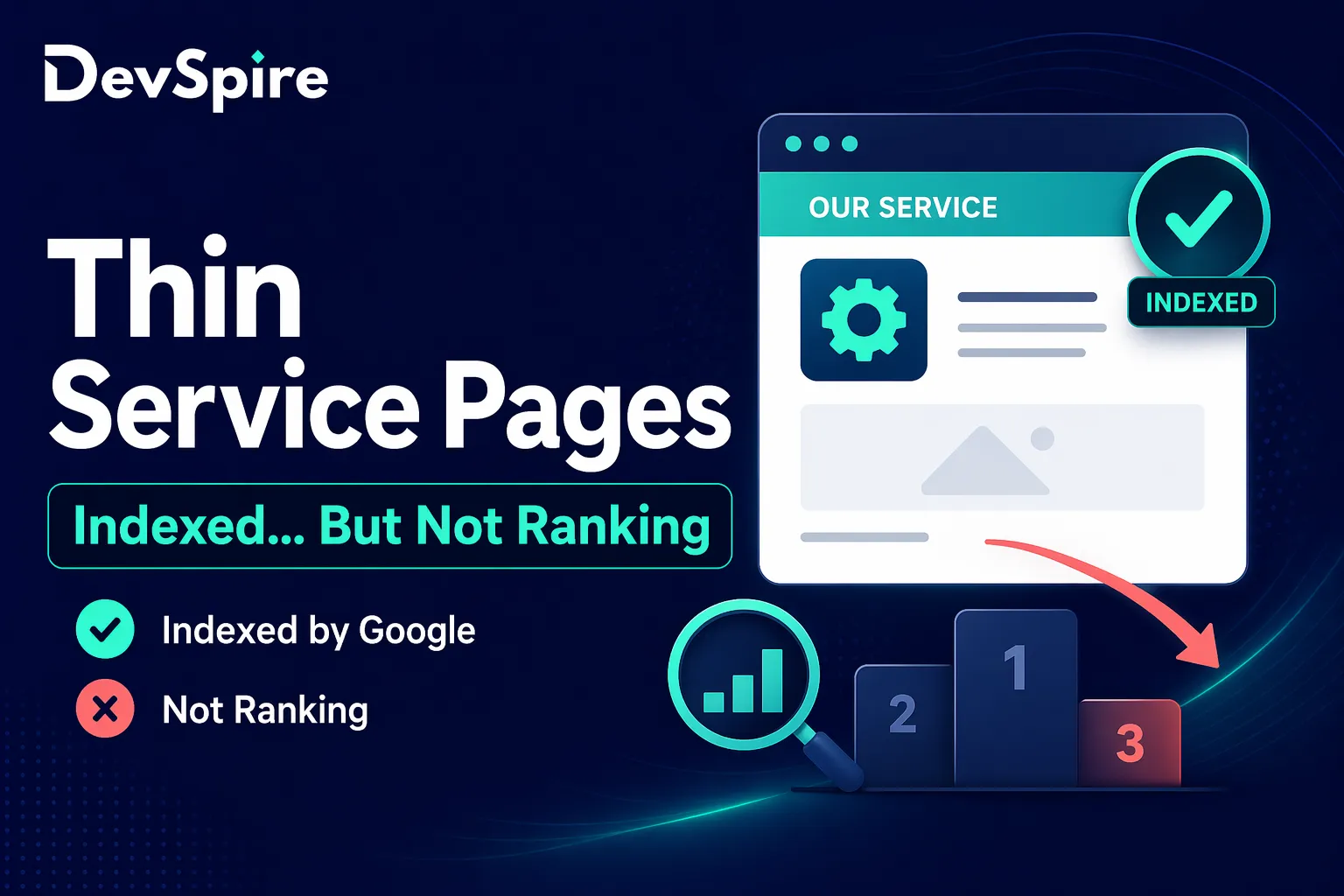
Getting indexed felt like progress. The page showed up in Search Console. The coverage report looked clean. You waited.
Then nothing. Zero impressions. Zero clicks. The page exists in Google’s index and Google has decided it is not worth showing to anyone.
This is the thin content problem. It is different from an indexing problem and it is more frustrating, because the page passed the first test and still failed. Google visited, looked at what was there, decided there was nothing useful for a searcher, and moved on.
Before going further: if your service pages are not getting indexed at all yet, that is a separate problem with its own diagnosis. Start with our guide on why service pages are not indexed. This article starts where that one ends. The page is in the index. It is just invisible.
For the full site architecture picture, our SEO strategy guide for service websites covers every layer from structure to content planning in one place.
What Thin Content Actually Means in 2025
Thin content is not about word count. Google does not have a minimum word count requirement. A 200-word page can rank if it fully satisfies the intent behind a query. A 900-word page can be thin if every sentence is generic.
Thin content means the page adds no original value to what already exists online. It answers no specific question. It addresses no specific buyer. It differentiates the business in no meaningful way.
Google’s Helpful Content system evaluates pages against one core question: does this page actually help the person who landed on it, or does it exist primarily to rank? Service pages built from a template, filled with phrases like “delivering results” and “client-focused solutions,” and never updated after launch are the most common examples of thin content we see in practice.
The problem is almost always structural. Most service pages were written to exist, not to answer anything. They describe the service in vague terms, make claims without proof, and give Google nothing to work with when deciding whether this page helps a searcher better than the 40 other pages targeting the same keyword.
In content audits we run, this is the single most consistent pattern: pages built quickly from a template, published, and never treated as actual content assets. They look like service pages. They are not doing the job of service pages.
How Google Evaluates Page Quality on Service Pages
Google’s quality evaluation is not a single score. It is a combination of signals that together tell Google whether a page is worth surfacing for a given query.
Intent satisfaction is the first signal. Does the page fully answer what the searcher was looking for? A service page targeting “local SEO for restaurants” that never mentions restaurants, never addresses the specific challenges restaurants face with local search, and never explains how the service applies to that industry does not satisfy intent. It describes local SEO in general terms. General terms do not win specific queries.
Expertise signals come next. Does the page show that the person or business offering the service actually knows what they are doing? This means specific methodology, real process detail, and actual examples of outcomes. Not claims. Evidence. The difference between “we are experts in technical SEO” and “here is the 6-step technical audit process we run for every new client” is the difference between an assertion and a demonstration.
Trust signals matter more on service pages than on almost any other page type. A visitor landing on a service page is considering spending money. They need enough reason to believe the business is legitimate and competent before they take any action. Case studies, named client outcomes, certifiable results, team credentials, or a named process that shows how the work gets done. Any of these works. None of them is optional if the page is supposed to convert.
Differentiation is the signal most service pages fail entirely. Does the page explain why this business is the right choice over every other business offering the same service? If the answer is no, the page is interchangeable with every competitor. Google treats interchangeable pages as low value and ranks them accordingly.
Google’s Search Quality Rater Guidelines define expertise, authoritativeness, and trustworthiness as the core quality markers. On service pages, these signals have to come from content, because service pages rarely earn the volume of external links that would establish authority automatically. The content has to do the work.
Five Signs Your Service Page Is Thin
These are the patterns that show up most often in service page audits. If your pages match more than two of these, thin content is the reason they are not ranking.
Sign 1: The page could belong to any business in your industry. Remove your logo and company name. Read the page. Could a direct competitor publish it word for word without changing anything? If yes, the page has no differentiation. It is generic by definition, and Google has no reason to rank it over anyone else.
Sign 2: Every claim is unverified. “We deliver results.” “Our team is experienced.” “We provide exceptional service.” These are assertions with nothing behind them. Google’s quality raters are trained to identify pages that make claims without supporting proof. Every claim on a service page needs evidence: a number, a case study, a named methodology, a specific client outcome.
Sign 3: The page targets a buyer but describes no one. A strong service page addresses a specific buyer in a specific situation. “We help e-commerce brands reduce cart abandonment through technical SEO and page speed optimization” is specific. “We help businesses grow online” is not. If the page does not describe who it is for in concrete terms, it fails intent satisfaction for every visitor who lands on it.
Sign 4: There is no process or methodology. Buyers hiring a service provider want to know how the work gets done, not just what the outcome is supposed to be. A service page that describes outputs but never explains the process is missing one of the strongest trust and differentiation signals available. Process detail is proof of competence. No process detail means no proof.
Sign 5: The page was built from a template and never updated. If every service page on your site follows the same structure, uses the same paragraph lengths, and covers the same generic points in the same order, the pages read like templates because they are templates. Google’s systems detect content pattern uniformity across a site and it factors into quality evaluation.
What a Strong Service Page Actually Contains
The difference between a ranking service page and a thin one is not length. It is specificity, proof, and differentiation. Here is what that looks like in practice.
A specific, named buyer. The page opens by addressing who it is for in concrete terms. Industry, business size, situation, or problem the buyer is trying to solve. This immediately satisfies the intent of a qualified visitor and signals to Google that the page has a defined, specific target.
A clear process section. Three to five steps that explain how the service is delivered. Not generic phases like “discovery, strategy, execution.” Actual process detail that shows the business has done this work before and has a repeatable method. The more specific the process, the stronger the expertise signal.
At least one proof element. A case study, a named client outcome, a specific result with a number attached. “We helped a plumbing company increase Google Business Profile calls by 40 percent in 90 days” is a proof element. “We get results for our clients” is not. One real proof element does more for page quality than 500 words of generic copy.
Objection handling. A section that addresses the questions a qualified buyer brings to the page before they contact you. Pricing transparency, timeline expectations, what is included and what is not, what happens if results are slow. Pages that address objections convert better and rank better because they satisfy more of the buyer’s full intent.
A single, clear call to action. One next step. Not a contact form, a phone number, a newsletter signup, and a case study download all competing for attention on the same page. One action that matches what a buyer at this stage of the decision process would logically take next.
The Difference Between Rewriting and Adding Value
Most thin service page advice tells you to add more words. That is the wrong fix. Adding generic paragraphs to a thin page makes it a longer thin page. The word count goes up. The quality signal stays flat.
A rewrite that works adds specificity, proof, and differentiation. It makes claims that are unique to this business. It speaks to a buyer in a way that does not exist anywhere else on the web in exactly that combination.
Before rewriting any thin service page, answer these five questions first:
Who specifically is this page for? What problem does this service solve for them? What is the one thing about how we do this work that no competitor does the same way? What proof do we have that this works? What is the one thing a buyer needs to know before they contact us?
The answers to those five questions are the content. Everything else is filler.
When we sit down to audit thin service pages, the content problem almost always starts before the writing. The business has not decided what makes them different. So the writer has nothing specific to say, and the page ends up saying nothing. Fixing thin content starts with answering those five questions, not with opening a doc and writing more of the same.
Is Your Site Structure Making Thin Pages Worse
Thin content does not exist in isolation. On most service websites, structural problems make it worse.
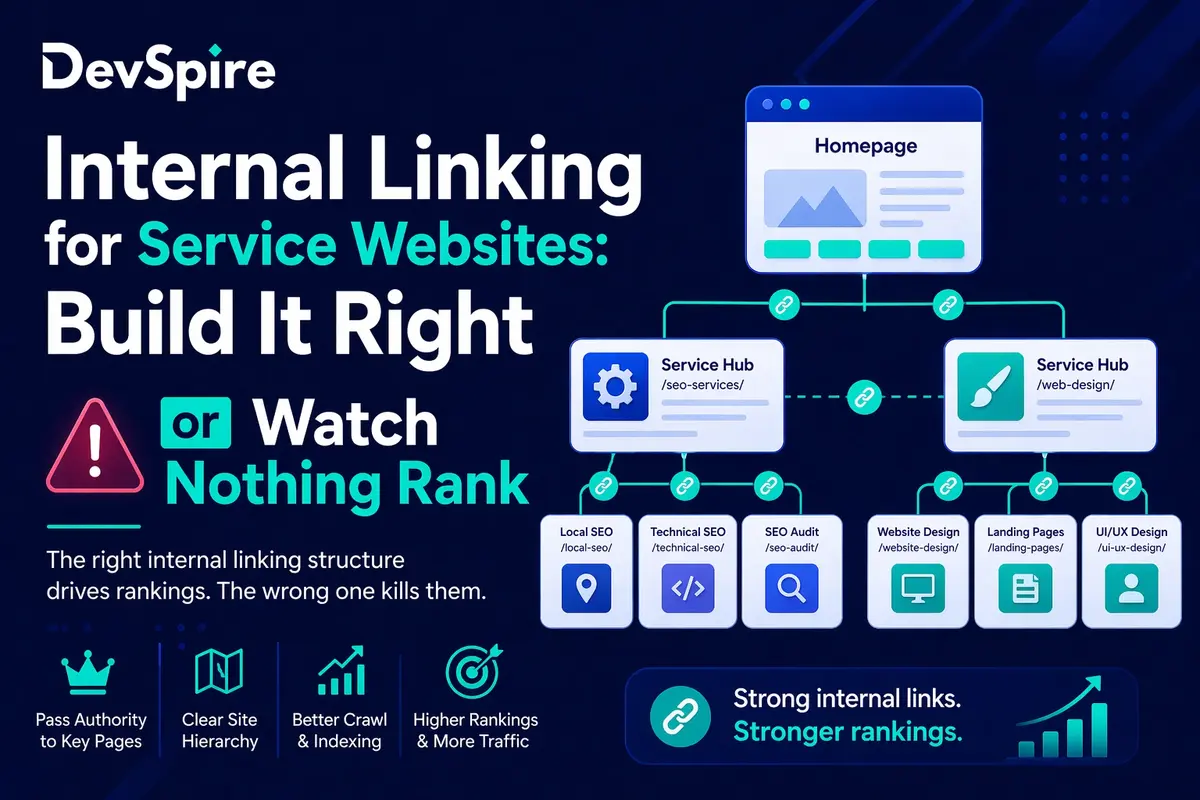
When service pages have no internal links pointing to them, they get less crawl attention and less authority, which compounds the quality problem. A thin page with no internal links is doubly deprioritized. For a full breakdown of how to build a linking structure that moves authority to the right pages, our guide to internal linking for service websites covers it in detail.
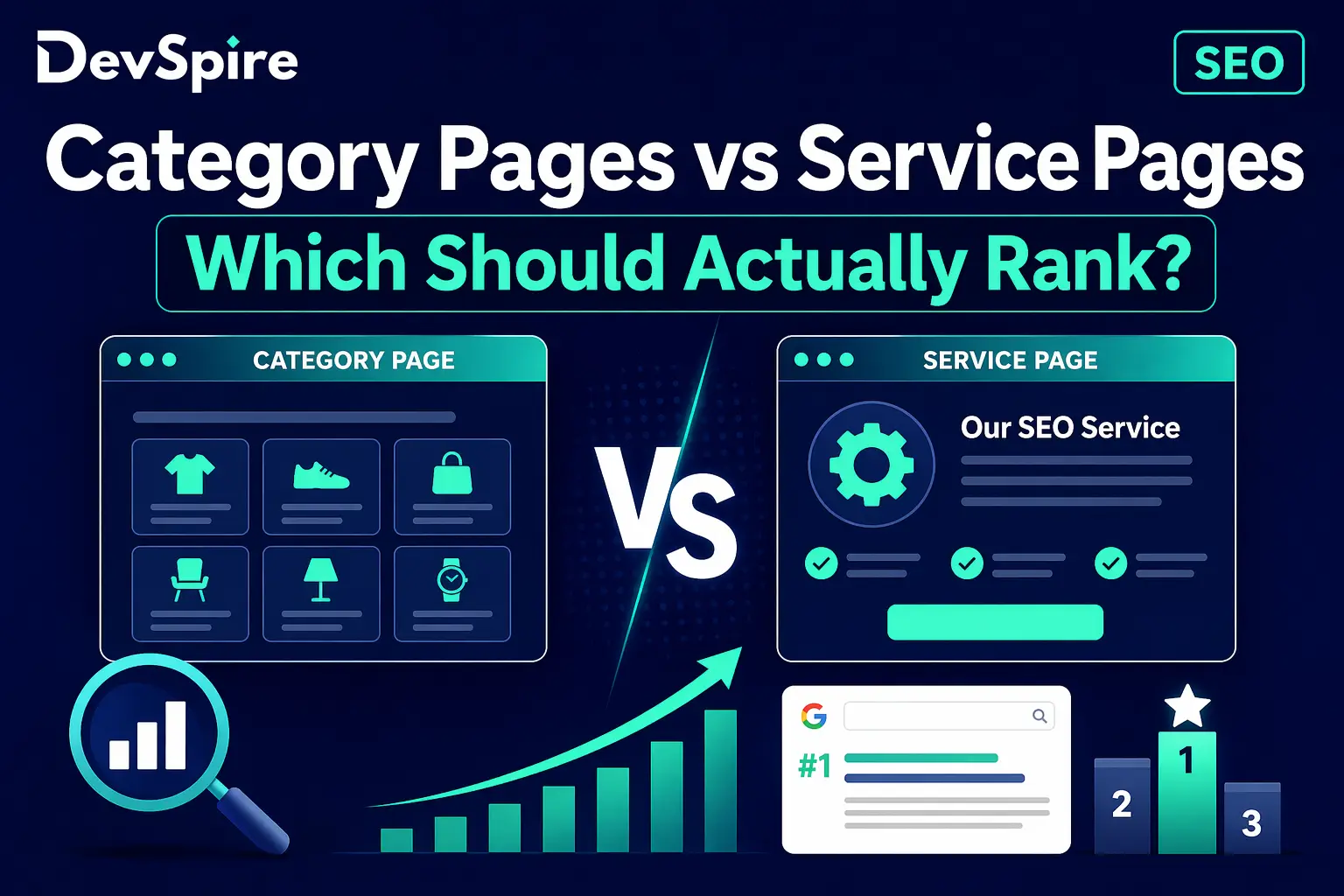
When category pages and service pages are targeting the same keyword, thin service pages lose the ranking contest to their own parent pages, which have more links and broader authority. If you are dealing with that problem, our article on category pages vs service pages SEO explains how to separate them so Google ranks the right one.
Structure and content are not separate problems. They compound each other in both directions. Fix the content and the structure problem gets easier to solve. Fix the structure and the content has a better chance of performing.
Quick Content Audit for Thin Service Pages
Five checks you can run today without a paid tool.
- List every service page on your site. Open each one and ask one question: does this page address a specific buyer with a specific problem, or does it describe a service in general terms? Mark each page as specific or generic. The generic ones are your thin content candidates.
- Open Google Search Console. Filter by each service page URL. Check impressions over the last 12 months. A page with zero or near-zero impressions and no upward trend is a thin content problem regardless of word count.
- Read the first paragraph of each service page out loud. If it could belong to any competitor without changing a word, the page has a differentiation problem. That paragraph sets the tone for everything Google reads after it.
- Count the proof elements on each page. Case studies, named outcomes, specific results, methodology descriptions. Any page with zero proof elements is a thin page, full stop.
- Check the call to action on each page. Multiple competing CTAs or no CTA at all are quality signals Google’s systems factor into whether a page satisfies commercial intent. One clear action per page is the standard a ranking service page meets.
A service page with zero impressions is not a traffic problem. It is a content problem. Google visited, found nothing it could use to match the page to a real searcher’s query, and moved on.
The fix is not adding more of the same content. It is adding the specific detail, proof, and differentiation that makes the page worth surfacing. Fix the content and the impressions follow. Once impressions are there, rankings come next. That is the sequence, and it starts with understanding what thin actually means and what strong actually looks like in practice.
Need Answers?
Frequently Asked Questions
These are the questions we get asked most often. They cover the main concerns most people have before getting started.
- Share
How Much Does a Custom Website Cost in 2026?
Internal Linking Structure for Service Websites That Rank

5 Ways Custom WordPress Development Services Can Grow Your Business
Category Pages vs Service Pages SEO: Which One Should Actually Rank
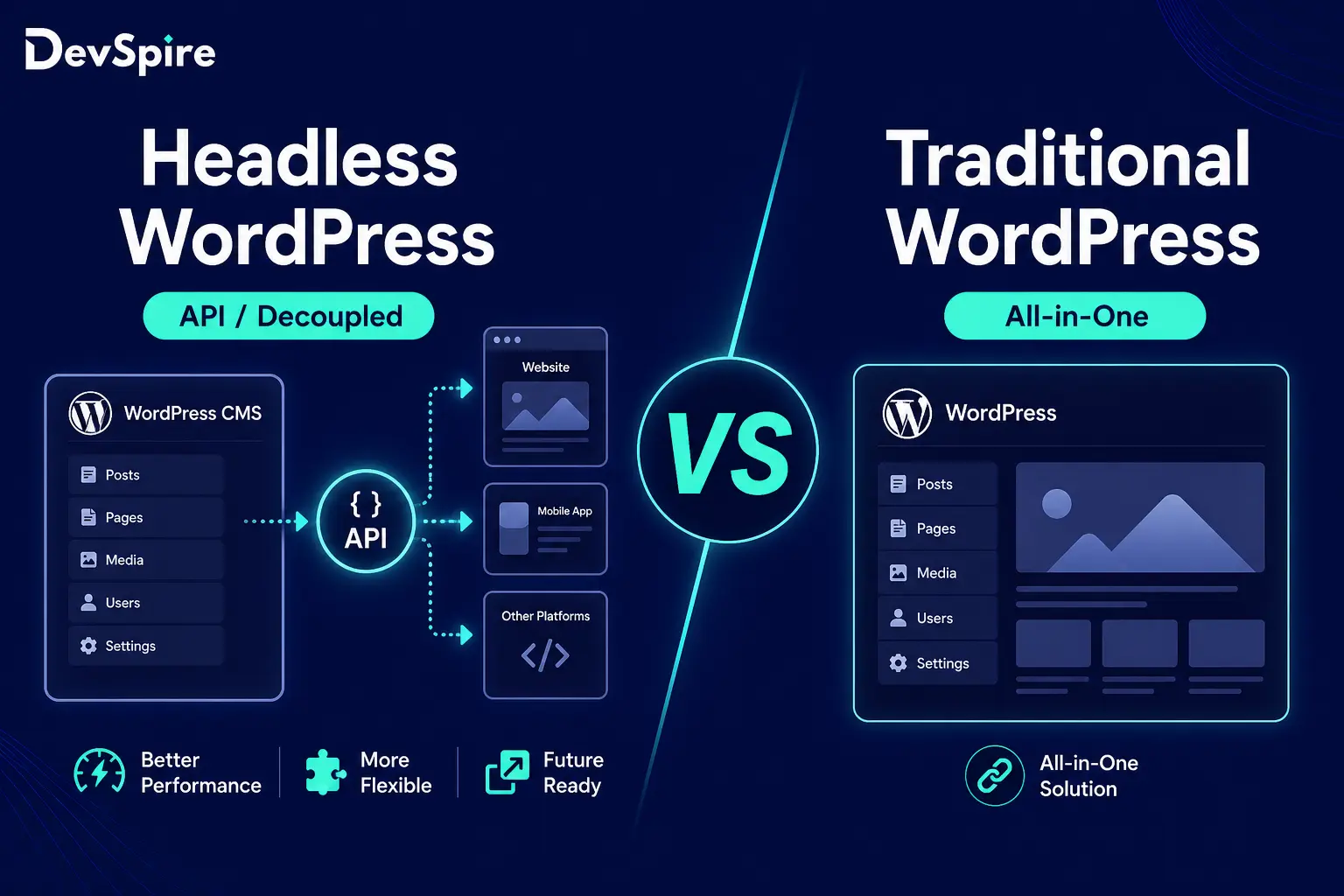
Headless WordPress vs Traditional WordPress: Which Is Right for You?
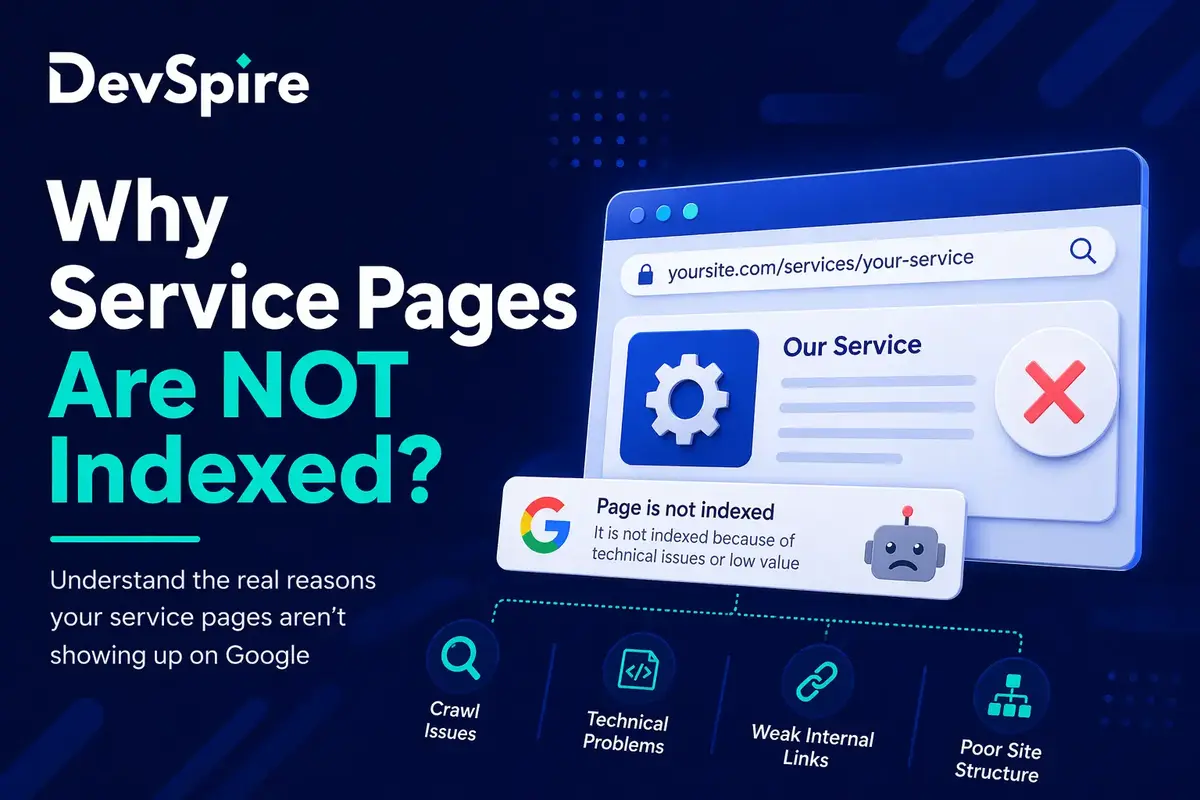
Why Your Service Pages Are Not Getting Indexed
SEO for Service Websites: Strategy Guide for Multi-Service Businesses

Top 10 Best Technical SEO Agencies in 2026
Your Website Is Not Generating Leads (5 Signs You’re Losing Clients)
- Tags
Tags
Related Insights
Our Client
Trusted by Industry Leaders
We collaborate with innovative companies to deliver intelligent web and mobile solutions. Our clients rely on DevSpire Inc. for digital products that are secure, scalable, and built to make a meaningful impact.





Our clients span industries and regions, from ambitious startups to established enterprises. They trust DevSpire Inc. to deliver innovative web and mobile solutions that are reliable, scalable, and built to drive results.
Our Work
Projects That
Deliver Results
From web and mobile applications to SaaS and AI-powered solutions, DevSpire Inc. creates digital products that transform businesses, engage users, and drive measurable impact.
Testimonial
What our
client say
Our clients trust DevSpire Inc. to deliver digital products that combine innovation, intelligence, and performance. From seamless web platforms to AI-enhanced mobile apps, we help businesses achieve their goals and create meaningful impact.
- DevSpire transformed our vision into a seamless mobile app. Their creativity and technical expertise are unmatched.
CEO Innovative Startup
- The team built a web platform that performs flawlessly. User experience and speed exceeded all expectations.
CTO Growing Enterprise
- AI features integrated by DevSpire have streamlined our operations and boosted customer engagement significantly.
Product Manager Tech Company
- Working with DevSpire was effortless. Their strategic approach and attention to detail made all the difference.
Founder SaaS Startup
- Their solutions are secure, scalable, and future-ready. DevSpire truly delivers digital products that drive results.
Operations Head E-commerce Company
- DevSpire transformed our vision into a seamless mobile app. Their creativity and technical expertise are unmatched.
CEO Innovative Startup
- The team built a web platform that performs flawlessly. User experience and speed exceeded all expectations.
CTO Growing Enterprise
- AI features integrated by DevSpire have streamlined our operations and boosted customer engagement significantly.
Product Manager Tech Company
- Working with DevSpire was effortless. Their strategic approach and attention to detail made all the difference.
Founder SaaS Startup
- Their solutions are secure, scalable, and future-ready. DevSpire truly delivers digital products that drive results.
Operations Head E-commerce Company
- DevSpire transformed our vision into a seamless mobile app. Their creativity and technical expertise are unmatched.
CEO Innovative Startup
- The team built a web platform that performs flawlessly. User experience and speed exceeded all expectations.
CTO Growing Enterprise
- AI features integrated by DevSpire have streamlined our operations and boosted customer engagement significantly.
Product Manager Tech Company
- Working with DevSpire was effortless. Their strategic approach and attention to detail made all the difference.
Founder SaaS Startup
- Their solutions are secure, scalable, and future-ready. DevSpire truly delivers digital products that drive results.
Operations Head E-commerce Company
- DevSpire transformed our vision into a seamless mobile app. Their creativity and technical expertise are unmatched.
CEO Innovative Startup
- The team built a web platform that performs flawlessly. User experience and speed exceeded all expectations.
CTO Growing Enterprise
- AI features integrated by DevSpire have streamlined our operations and boosted customer engagement significantly.
Product Manager Tech Company
- Working with DevSpire was effortless. Their strategic approach and attention to detail made all the difference.
Founder SaaS Startup
- Their solutions are secure, scalable, and future-ready. DevSpire truly delivers digital products that drive results.
Operations Head E-commerce Company
Your Next Digital Breakthrough
Ready to Turn Your
Vision Into Reality?
Whether you’re launching a new product, scaling your SaaS platform, expanding your development team, or accelerating growth through digital marketing, DevSpire Inc. is ready to support your journey. We combine strategy, technology, and execution to build secure, scalable, and results-driven digital solutions tailored to your business goals.
Prefer to share your requirements first? Provide your project details below and our team will get back to you within 24 hours.
Your information is kept confidential and will never be shared.
What Happens Next?
1. Requirement Discovery
Our experts dive deep into your project needs, analyzing goals, challenges, and opportunities to craft a tailored solution strategy.
2. Strategic Alignment Call
We connect with you to clarify objectives, confirm timelines, discuss resources, and establish a clear roadmap. NDAs can be signed to ensure full confidentiality.
3. Custom Proposal & Project Kickoff
You receive a comprehensive proposal detailing scope, team composition, milestones, and budget. Once approved, we immediately begin executing your project with precision and accountability.