Most agency comparisons read the same way: a list of “things to look for” that could apply to hiring a plumber or a marketing consultant. That’s not much help when you’re trying to decide who builds the app your business will run on for the next three to five years.
This guide breaks the decision down the way it actually happens: agency type, tech stack recommendation, pricing model, and the questions that separate a solid partner from one that disappears after launch. If you’re comparing options in Charleston or anywhere else, the same framework applies. For reference, DevSpire has been through this evaluation process with clients across several industries, so the criteria below come from real project patterns, not a generic checklist.
What Type of Agency Are You Actually Hiring?
Not every “app development agency” does the same job. Before you get to pricing or tech stack, figure out which category you’re dealing with.
Full-service agencies handle design, development, QA, and post-launch support under one roof. You get a single point of contact and fewer handoffs, but you’re paying for that convenience.
Development-only shops expect you to bring your own designs or product manager. Cheaper per hour, but only a good fit if you already have someone managing the project internally.
Freelance collectives and dev networks are the lowest cost option and the least predictable. Quality depends entirely on who gets assigned to your project, and accountability is thin if something goes wrong mid-build.
| Agency type | Typical cost | Best fit | Biggest risk |
|---|---|---|---|
| Full-service | Higher | Businesses without an internal PM | Slower, more layers |
| Dev-only | Mid | Teams with their own design/PM | You own the coordination |
| Freelance network | Lowest | Small, simple builds | Inconsistent quality |
If you’re weighing full-service against a leaner setup, it helps to look at what a mobile app development company actually includes in scope before you compare quotes, since “development” means very different things depending on who you ask.
Native, Hybrid, or Cross-Platform: Who’s Actually Right?
This is where a lot of agencies reveal whether they’re solving your problem or just selling their default stack.
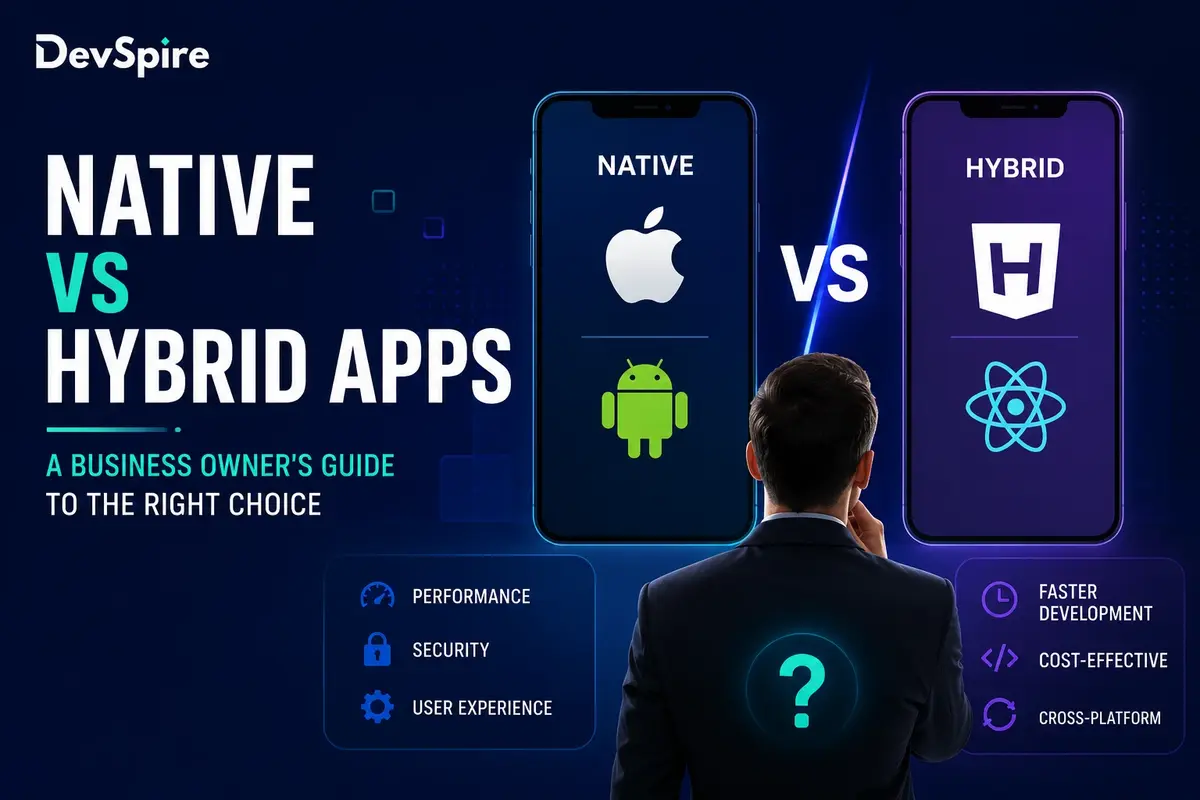
Native (Swift for iOS, Kotlin for Android) gives you the best performance and full access to device features. It costs more because you’re essentially building two apps, and it takes longer.
Cross-platform (Flutter, React Native) lets one codebase run on both platforms. Development is faster and cheaper, which makes it a reasonable choice for an MVP or a straightforward business app.
Hybrid and PWA approaches are the cheapest option but come with real limits on native device features like camera integration or offline performance.
Here’s the test: if an agency recommends the same stack regardless of what you’re building, ask why. A booking app for a local service business has different needs than a fintech product handling sensitive data, and the recommendation should reflect that.
Fixed Price vs. Time and Materials vs. Dedicated Team
Pricing structure affects your project almost as much as the developers themselves.
Fixed price works when your scope is well defined and unlikely to change. The risk shows up the moment you want to add a feature mid-project, since every change becomes a negotiation.
Time and materials billing suits projects where requirements will evolve, which is most real-world apps. The tradeoff is that your budget can run over if nobody is tracking hours closely.
Dedicated team arrangements make sense for long-term products that need ongoing development, not just a single launch. You’re essentially hiring an extension of your team, which means you also need to manage them like one.
None of these is objectively better. The right model depends on how clear your requirements are today and how much they’re likely to shift once real users start using the app.
Portfolio Red Flags vs. Green Flags
Anyone can put screenshots on a website. What separates a strong portfolio from a padded one is what’s missing.
Green flags: case studies that mention actual outcomes, retention numbers, load times, App Store ranking improvements, not just “we built this app.” Apps that are still live and getting updates on the App Store or Google Play. References you can actually contact.
Red flags: portfolios with only screenshots and no results mentioned anywhere. Apps that were pulled from the stores or haven’t been updated in years. Case studies with no client name attached, which usually means the client wasn’t happy enough to be named.
Check the App Store listing directly. A five-star rating with three reviews tells you almost nothing. A 4.2 with 400 reviews tells you a lot more, including what real users complained about.
In-House Team vs. Outsourced Agency
Some businesses reach this stage still unsure whether they need an agency at all.
Hiring in-house means recruiting, onboarding, and paying salaries for four to six specialized roles: iOS developer, Android developer, backend, QA, and often a designer. That’s a meaningful fixed cost even before the app exists.
An outsourced agency spreads that cost across their client base, which is why it’s usually cheaper for a single project, and faster to start since you’re not recruiting from scratch. The tradeoff is that you’re depending on a team that also has other clients.
For most small and mid-size businesses, working with an established mobile app development services provider ends up being the more practical route, at least until the app has grown enough to justify building an internal team.
Questions to Ask Before You Sign
A proposal will tell you what an agency wants you to know. These questions get at what actually matters once the contract is signed.
- Who owns the code and intellectual property after launch?
- What does your QA process look like before App Store or Play Store submission?
- Do you handle store rejections, and who’s responsible for resubmission?
- What happens if a developer leaves mid-project? Is there documentation for handoff?
- How do you handle post-launch bugs, and is that covered in the original quote or billed separately?
- Can I see the actual development environment or a live demo before final payment?
If an agency gets vague or defensive about any of these, that’s worth noting before you sign anything.
Quick Checklist
- Confirm agency type: full-service, dev-only, or freelance network
- Ask why they’re recommending native, cross-platform, or hybrid for your specific case
- Understand the pricing model and what triggers a change order
- Check the App Store listing of past apps, not just the portfolio page
- Get clear answers on IP ownership and post-launch support
- Talk to at least one past client directly
Where This Leaves You
There’s no single “best” agency, only the one whose approach matches what you’re actually building. A simple booking app doesn’t need the same team as a data-heavy fintech product, and paying for that mismatch either way costs you.
If you’re at the point of comparing quotes, it’s worth having a direct conversation about your specific use case before committing to a stack or a pricing model. You can get in touch with DevSpire to walk through your project and get a scoped answer instead of a generic quote.